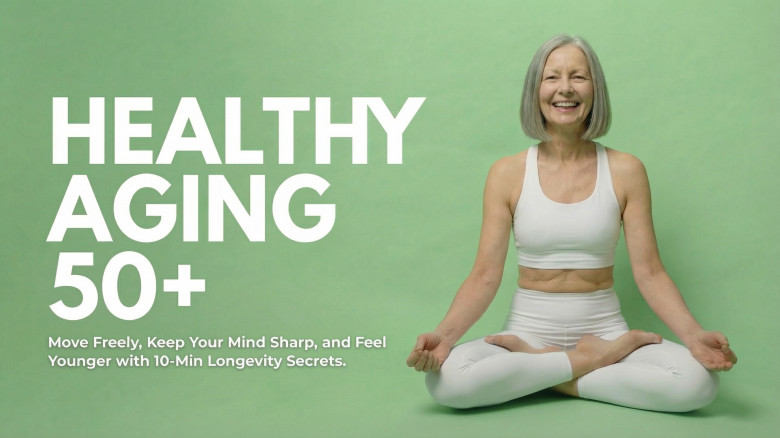
Healthy Aging 50+ : Move Freely, Keep Your Mind Sharp, and Feel Younger with 10-Min Longevity Secrets
Do you wake up with stiff joints, brain fog, low energy, or heavy legs? Many women 50+ call it “just aging.” But when your body feels tight, your mind feels foggy, and your confidence drops, daily life gets harder. Healthy Aging 50+ is a gentle 10-minute at home Qigong practice to help you move easier, think clearer, support circulation and balance, and feel steadier — without strain, long workouts, or complicated routines.
Created by
Vadim Levashov
About this course
Start today and feel more like yourself again.
Many women over 50 begin to notice changes like:
- Morning stiffness in the knees, hips, shoulders, or lower back
- Brain fog, slower recall, or moments when focus feels less reliable
- Low energy that makes even simple tasks feel heavier
- Aching joints after sitting, walking, or standing too long
- Heavy legs, tension, or a sense that circulation is not what it used to be
- Concern about blood pressure, hypertension, or feeling less steady when stress builds up
- Balance that feels less reliable than it used to
- Moving more carefully because your body feels tight, slower, or unsteady
- A quiet fear that this is “normal aging” and may only get worse
These changes are often dismissed for too long.
But when your body stops moving well, everything feels harder — walking, bending, climbing stairs, getting up from a chair, staying focused, feeling emotionally steady, and trusting your body again.
Over time, many women start worrying not only about mobility, but also about circulation, high blood pressure, depression, Alzheimer’s, dementia, and the fear of slowly becoming less independent.
Healthy aging is not about pushing harder.
It starts when you help the body move better, support circulation, improve stability, and reconnect the brain and body through gentle daily movement.
This gentle daily practice works with the body as one connected system.
It helps you:
- Move more easily in the morning and throughout the day
- Feel less stiff, tight, and restricted in your joints
- Support healthy circulation and a calmer response to daily stress
- Build healthier daily habits for blood pressure and whole-body vitality
- Feel more mentally clear, focused, and present
- Support long-term brain health and cognitive resilience
- Improve balance, posture, and body awareness
- Feel lighter in the legs and more confident walking, standing, and moving through daily life
- Support a steadier mood when stress, fatigue, and emotional heaviness usually take over
All movements are slow, controlled, and beginner-friendly — even if you have not exercised in years.
This is not about forcing the body.
It is about helping you feel more mobile, more stable, more mentally clear, and more like yourself again.
Many women try stretching, random online routines, or simply pushing through the stiffness.
But when your body already feels tired, tense, less stable, and mentally overloaded, more force is not always the answer.
Healthy Aging 50+ uses gentle Qigong-based movement and simple brain-body coordination to help your body respond without pressure.
You do not need punishing workouts.
You do not need to “push through it.”
You do not need to ignore stiffness, brain fog, low energy, circulation concerns, or blood pressure worries until they become your new normal.
You need a method your body can trust and repeat.
This practice offers:
- Gentle Qigong flows for stiff joints and tight muscles
- Brain-activating patterns to support focus, memory, and coordination
- Joint-friendly movement that feels safe and manageable
- A calm pace that supports confidence instead of overwhelm
- Short sessions that fit real life
This is healthy aging support for real bodies — not another workout you will dread.
You do not need long workouts.
You need a clear, gentle method that supports your body and mind together.
Step 1: Wake Up Your Body
Start with simple movements for the spine, hips, knees, and shoulders to ease stiffness, improve circulation, and help the body feel lighter.
Step 2: Activate the Brain and Body Together
Add gentle coordination patterns that challenge the body and mind in a safe way. This helps support mental clarity, attention, and body awareness.
Step 3: Improve Stability and Movement Confidence
Use balance, posture, and core-focused movement to help you feel more steady on your feet and more supported in everyday motion.
Step 4: Reset Energy and Inner Balance
Finish with calming Qigong flows and breathing that help the body release tension and leave you feeling more refreshed, clear, and grounded.
Just 10 minutes a day can help you feel more mobile, more focused, and more like yourself again.
- Only 10 minutes a day
- Gentle and beginner-friendly
- No jumping, no strain, no intimidating workouts
- No equipment needed
- Suitable even if you feel stiff, tired, or out of shape
- Supports joints, posture, balance, circulation, and mental clarity
- Easy to do at home, at your own pace
- Designed for long-term comfort, confidence, and healthy aging
Move with more ease. Think with more clarity. Feel more confident in your body again.
Course includes
What learners say
“My biggest fear was not just my stiff joints. It was the feeling that I was becoming older faster than I should. I’m 58, and I had started dealing with brain fog, a heavy lower body by evening, and more anxiety around blood pressure because it runs in my family. I wanted something safe, not another routine that made me feel behind. This practice gave me exactly that. My mornings feel lighter, my hips feel more open, and I do not get that same drained, foggy feeling by afternoon. I feel more like myself again.”
“At 63, I noticed that simple things were starting to take more effort. Stairs felt different. Getting up from a chair felt different. My balance felt less reliable, my knees were stiff, and on stressful days I could actually feel my blood pressure rising. What I love about this program is how calm and manageable it feels. Nothing is aggressive, but it still works. I feel more stable on my feet, less tight through my shoulders and hips, and much more mentally clear. It feels like I am supporting my future, not just reacting to symptoms.”
“I’m 55, and what bothered me most was the combination of low energy, aching joints, and feeling mentally slower than I used to. That scared me more than I wanted to admit, especially with a family history of dementia and depression. I didn’t want a bootcamp. I wanted something I could keep doing. These sessions are short, gentle, and surprisingly effective. I move more easily now, I feel more focused during the day, and I no longer feel trapped in that tight, tired state that used to follow me everywhere.”
“At 61, I had started telling myself this was all just normal aging — the stiffness, the heaviness in my legs, the slower thinking, the lack of energy. But deep down I was worried about where it was all heading: hypertension, memory decline, losing independence. This practice felt different from day one because it did not ask me to force anything. It helped me reconnect with my body in a calm way. I feel steadier, my circulation feels better, my posture has improved, and my mind feels much less cloudy than before.”
“I’m 67, and I was looking for something that supported both body and mind. I had tight hips, shoulder tension, and periods of real brain fog where I just did not feel sharp. I also knew I needed better habits for healthy aging, especially with worries about Alzheimer’s and mood changes later in life. This gave me a routine I can actually stay consistent with. I feel more fluid in my body, more confident walking, and more emotionally steady too. It’s gentle, but it changes how I feel every single day.”
“What surprised me most was how much this helped my confidence. I’m 59, and I had begun moving more carefully because I didn’t trust my body the same way anymore. My joints felt stiff, my legs felt heavy, and stress would hit me physically — especially through tension and blood pressure worry. I needed something that felt safe enough to repeat. After a few weeks, I felt more upright, more stable, and much less afraid of movement. Even my focus improved. It feels like I got a part of myself back.”